I should have seen that my happiness would eventually adapt to this new life in Sierra Leone. And yet, as I know from all the research I’ve done into happiness, humans rarely foresee that they will adapt to many a change in life circumstances. Somehow, knowledge doesn’t make one immune. Still, at least I didn’t let my inability to predict that I’d adapt prevent me from coming here in the first place.
Respite and Return
But let’s begin with being back in Edinburgh for several weeks, which did me a world of good. For the first few days, I had a profound sense of freedom.
There were many big sighs in public – all came unforced, unannounced, unrivalled. The delight of a light breeze flickering over my skin and a wee tingle up the spine; the gentle shine of the sun warming my face; my belly about to be filled with something not even that delicious but easy to come by – many a priceless moment to appreciate.
Better sleep. Guts felt good. Virtually nothing to stress about. It’s all relative, of course. But I didn’t feel an ounce of anxiety. Not like I used to at regular day-to-day things – what now seem like small fry difficulties when compared to the challenge of living in Freetown.
Bless the life I used to have in Edinburgh. Long-time friends, familiar places, the occasional escape to the hills for some walking and camping, all made for an exquisite respite.
And so, when I returned to Freetown, I noticed that there had been some profound physical and psychological shifts since I first arrived here early this year.
Not Getting Lost in Loss
Whenever life changes, whether it be through personal choice or not, it is often what’s lost that is the most salient. There are many studies demonstrating that losing something dominates how we feel in comparison to when we gain it. The psychological pain of losing a job, the loss of health, or the loss of a loved one, all have large impacts on our happiness. There is very little, if anything, that compares in magnitude from a positive perspective – a promotion, a pay rise, getting married – all minor in comparison.
I’ve sometimes been so preoccupied lamenting the things I no longer have here in Freetown that it’s been difficult to see how much I still have in my life, and indeed what I have gained. Too much time lamenting? I don’t know! It’s a natural process – the focus on losses. It’s a sort of grieving – and perhaps a necessary process we have to go through if we are to rebuild ourselves in our new life and open the door to appreciating what is present. What surprises me is that it just didn’t cross my mind that I might be over-focusing at least a little on loss and cut myself a bit more slack on some of those darker days.
Adaptation
But it took a while to see these gains, partly because it took a while to bring those gains in. There is a psychological adaptation – where things remain largely the same, but the painful feeling of loss diminishes with time. We get used to things as they are and the same daily challenge loses the emotional impact it once had on us.
Then there is the physical adaptation, where new ways are found to meet previously unmet needs. It has taken longer to do that. I now eat, drink, exercise, engage with nature differently than I did.
Again, I can’t be too hard on myself; adaptation is a natural process, much as is failing to predict it happening in the first place. The first 6 months were always going to be the most difficult. It would be weird if they weren’t. The fear, I suppose, is that they remain difficult.
A Paradise Now Remembered
But perhaps a more surprising turn of events is what’s happened to life back in Edinburgh. Well, nothing. It was largely the same as when I’d left. Overrun with tourists during The Fringe, as ever, but otherwise the same ‘paradise’ it always was. What was different was me. My experience of the last six months forced a re-evaluation of all life that came before. What I thought was a very excellent life now seems even better than that. A frigging paradise…
I hadn’t expected this at all. It’s a relative comparison, of sorts – whereby we compare to others and realise we have a lot more than we realise to be wholeheartedly grateful for. But it feels more than that, that I’ve redefined what a good life involves: that my 10 out of 10 life back in Edinburgh now feels like it was actually an 11 out of 10 life. Life is hard here in Freetown and it will continue to be so. No doubt about that. But I’ll feel better about life here if I shift how I think about what’s possible. And not only that, but my time here is likely to enrich my perspective for the rest of my days.
The Important Part
But my surprise from experiencing all these psychological effects aside, they are natural. What really matters is whether I let them affect my choices. Loss does hit us hard; we do underestimate how much physical and psychological change we’ll go through, and it can be painful. The important part is whether those unexpected impacts change how we respond: does the worry about that possibility of not adapting change our decisions? Do we hold on to something that is long over? Do we avoid the present?
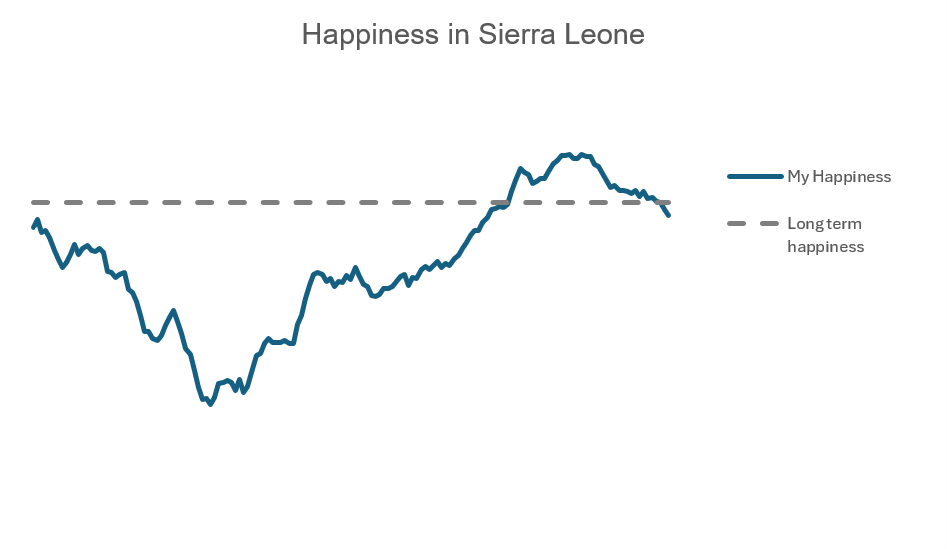
I’m trying not to. But there is work to do – I’ve been back over a month now and I’ve been bounding upward on the high of being back in Edinburgh, and I can see that my happiness is taking a bit of a downward turn (see that graph) – I’ll keep a watch on that. And I certainly don’t want to let myself start thinking that there is something wrong with me – it’s normal, it’s natural, I want to stay open to the experience as it is – that’s always brought forth a deeper happiness.

